
Mesh MEA™ for 3D Cell Culture Electrophysiology
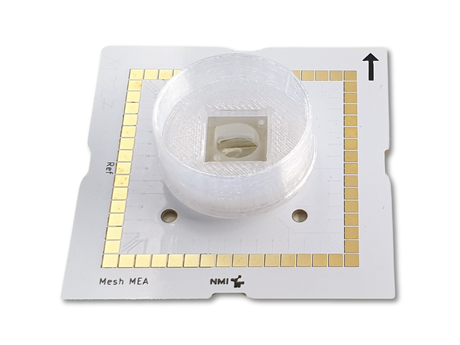



Record Electrophysiological Activity from Within Intact 3D Tissue Models
Traditional microelectrode arrays were designed for monolayer cultures. As organoids, assembloids, spheroids, and other advanced 3D models become increasingly important in neuroscience, disease modeling, safety assessment, and drug discovery, researchers need tools that can capture functional activity without disrupting tissue architecture
Mesh MEA™ is a unique scaffold-based microelectrode array that enables long-term electrophysiological recordings from the interior of intact 3D tissue models. By allowing cells to grow naturally around the mesh and electrodes, Mesh MEA preserves physiologically relevant morphology while providing access to functional signals from throughout the tissue structure.
Read More on Our Blog (link is external) Watch Videos (link is external)

Why Mesh MEA?
Move Beyond Surface Recordings
Conventional planar MEAs primarily record activity from cells in contact with the electrode surface. For complex 3D tissues, this means much of the biological activity occurring deeper within the structure may go undetected.
Mesh MEA enables cells to envelop the electrodes, allowing recordings from within the tissue itself rather than solely at the surface. This provides a more representative view of network activity and tissue function.

Preserve Native 3D Tissue Architecture
When 3D tissues are cultured on traditional planar arrays, they often flatten and deform. These structural changes can alter cellular organization and electrophysiological behavior.
Mesh MEA supports organoids, assembloids, neurospheres, and spheroids without compression, helping maintain native morphology, cellular composition, and electrical activity throughout the experiment.
Perform Long-Term Functional Studies of Organoids
Monitor the same tissue sample over extended culture periods and perform repeated measurements without disrupting the model. Longitudinal recordings reduce biological variability while enabling researchers to follow network development, maturation, disease progression, or treatment response over time.

Order Mesh MEA Online (link is external) Questions? Consult our PhD Expert Team (link is external)
Capture What Conventional 2D Planar MEAs Miss
- Record extracellular activity from intact 3D tissues while preserving structure.
- Capture signals from deeper regions of organoids and spheroids.
- Generate long-term electrophysiological recordings from the same sample.
- Visualize electrical activity in real time.
- Combine recording and stimulation experiments to investigate connectivity and plasticity.
- Integrate electrophysiology with imaging workflows.
- Adapt acquisition and analysis workflows to your experimental requirements.
Designed for Advanced Organoid Electrophysiology
Mesh MEA is designed specifically for researchers working with advanced 3D cellular models. The platform enables functional measurements in complex tissues while preserving the biological characteristics that make organoids powerful experimental systems.
Ideal for:
- Cerebral organoids/brain organoids
- Hippocampal organoids
- Midbrain organoids
- Retinal organoids
- Cardiac organoids and cardiac bodies
- Neurospheres and spheroids
- Pancreatic islets
- Bioprinted 3D tissues
Applications:
- Drug discovery
- Precision medicine
- Safety pharmacology & toxicology
- Translational research
- Disease modeling
- Neuroscience
- Cardiac research
- Ophthalmology research
- New approach methodologies (NAMs) applications
See Data (link is external) Read More on Our Blog (link is external)

Compatible with the MEA2100 Series
Mesh MEA is compatible with HBio/Multi Channel Systems' MEA2100-Mini MEA system and the AcadeMEA™ single-well MEA system.
Order Mesh MEA Online (link is external) Request More Information More Organoid Research Solutions from HBio (link is external)

3D cellular structures self-assembling around the electrode-containing mesh. Photos courtesy of Jones’ lab, Biomedical Micro and Nano Engineering, NMI Natural and Medical Sciences Institute at the University of Tübingen.
Acknowledgment
Mesh MEA technology was developed in collaboration with Dr. Peter D. Jones and his research group at the NMI Natural and Medical Sciences Institute: Mesh Mikroelektroden Array | NMI.