
Mesh MEA
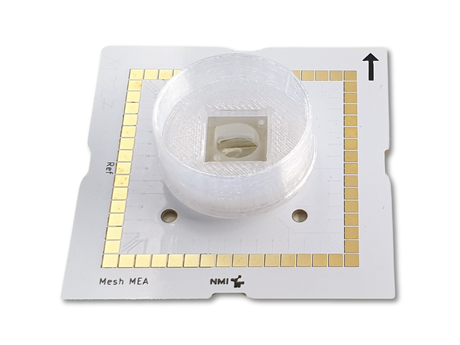



Generate true-to-life recordings from inside an organoid without compromising its structure for the first time. Multi Channel Systems’ Mesh MEA is a unique microelectrode array chip consisting of 60 electrodes on a slim polyimide mesh that enables cells to grow around the electrodes.
Why Mesh MEA?
- Record from inside an organoid: The cellular migration around the electrode-containing mesh enables monitoring signals from the organoid internal regions without compromising its structure.
- Collect electrophysiological data from an intact organoid: The mesh scaffold keeps the organoid suspended in a solution that protects and holds it in place and prevents morphological deformations of the organoid.
- Improve organoid maintenance: A perfusion system acts as a partial compensator for the lack of organoid vascularization.
- Long-term experiments: The undamaged organoid morphology and the longevity of maintenance allow multiple measurements in a single organoid.
- Flexible experimental settings: A user-defined air-liquid interface can be leveraged to facilitate organoid development and improve compound testing capabilities.
Key Features:
- 60-electrode flexible chip embedded in a slim polyimide mesh that promotes growth of cells around the electrodes
- Interelectrode distance of 200 µm and electrode (TiN) diameter of 30 µm
- Data is sampled at 50 kHz per channel at a 24-bit resolution
- Real-time signal detection and feedback
- Freely programmable digital signal processing
- Multiple inputs/outputs, including digital, analog, and audio
- SuperSpeed USB 3.0 ports
- Voltage and current stimulation possible
- Optical access from bottom
- Compatible with Multi Channel Systems' MEA2100 series headstages
Learn more about Mesh MEA for organoid electrophysiology.

3D cellular structures self-assembling around the electrode-containing mesh. Photos courtesy of Jones’ lab, Biomedical Micro and Nano Engineering, NMI Natural and Medical Sciences Institute at the University of Tübingen.
Acknowledgment
Mesh MEA technology was developed in collaboration with Dr. Peter D. Jones and his research group at the NMI Natural and Medical Sciences Institute: Mesh Mikroelektroden Array | NMI.